


Laundry symbols explained: how to wash your clothes sustainably (and without the panic)
You know the feeling. You're holding a new shirt, looking at the care label, and thinking: help. A bucket, a triangle, dots, lines, and somewhere a circle that no one ever explained. And yet, you are expected to handle this flawlessly.
Laundry symbols may not be sexy, but they are worth their weight in gold. They ensure your clothes stay beautiful, last longer, and prevent you from wasting energy, water, and frustration unnecessarily. At Natur-el, we get questions about this every day, so it’s time for a clear explanation. No jargon. Just honest tips you can actually use.
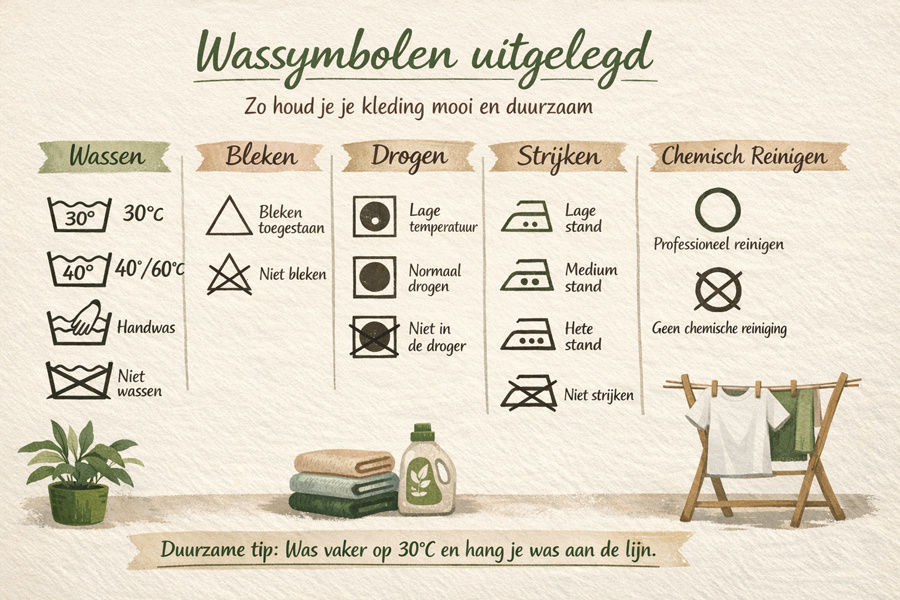
These are the most common laundry symbols:
Why laundry symbols are so important
Laundry symbols are not just for decoration or suggestion. They tell you exactly:
- at what temperature you can wash
- whether something can go in the dryer
- how to iron it safely
- and whether dry cleaning is an option
Ignore them, and you risk shrinkage, fading, or a sweater that is suddenly two sizes too small. A shame. Especially with sustainable clothing that is meant to last for years.
The most important laundry symbols explained
Washing: the bucket symbol
This symbol tells you if you can wash it and at what temperature.
- 30 degrees is a favorite at Natur-el. Clean enough and much less taxing on your clothes and the environment.
- 40 to 60 degrees should only be used if absolutely necessary.
- Hand wash is often seen on fine or delicate fabrics.
- A cross through the bucket means: do not wash yourself. Period.
- Wool wash: always choose this for wool. Always.
Our experience: about 80 percent of clothing is washed more often than necessary. Try hanging your laundry outside or over a chair for a night. It does wonders. For your clothes and for the world.
Bleaching: the triangle
Let’s be honest. You can usually ignore this symbol.
- Empty triangle: bleaching is allowed, but it’s not required.
- Cross through the triangle: do not bleach. Seriously.
At Natur-el, we sell clothing that doesn't need bleach to stay beautiful. In fact, we actively advise against using it.
Drying: the square with the circle
The dryer might be convenient, but it is also a clothes-destroying machine.
- Cross through the symbol: do not tumble dry.
- Dots: indicate whether a low or normal temperature is allowed.
Our tip is simple: hang your laundry up. Better for your clothes, better for the environment, and let’s be honest, the dryer should actually be banned.
Ironing: the iron
- 1 dot: low temperature
- 2 dots: medium
- 3 dots: hot
- Cross: do not iron, and yes, that is sometimes wonderful
Many fabrics become smooth enough if you just hang them up neatly. My golden tip: buy a handheld steamer. Super fast, no fuss with ironing boards, and it easily refreshes your clothes too.
Dry cleaning: the circle
You mainly see this symbol on coats and delicate materials.
- Usually the advice is: rather not.
- If it must be done, choose a cleaner that uses environmentally friendly methods.
How to wash as sustainably (and smartly) as possible
These are tips we literally share in the shop.
- Preferably wash at 20 or 30 degrees.
- Use the eco-setting at 40 or 60 degrees.
- Run a hot cycle with towels occasionally to keep your machine clean.
- Don't overfill, but don't run half-empty loads either. A drum that is 75 to 80 percent full is perfect.
- Use very little detergent. More foam does not mean cleaner.
- Remove your laundry from the machine immediately to prevent wrinkles.
- Wash inside out and close zippers and buttons.
- Use a laundry bag to prevent wear and microplastics.
- Skip the dryer.
And perhaps the most important tip: don't wash because you can, but because it is necessary.
Extra tips per material
Wool
Wool does not need to be washed often. Airing it out does wonders. If you do wash it, choose the wool program and use a wool detergent with lanolin such as Lanalicious. Pilling is normal with wool, which is why we are big fans of the Gleener. Never pull at pills; it only makes your fibers sad.
Organic cotton
Organic cotton can become a bit looser while wearing. No panic. After washing, it returns to its original shape. Drying and storing it flat prevents it from stretching out. Pro tip: after washing, gently pull the item into shape and place a thin towel underneath while drying to avoid lines from the drying rack.
Ecovero and Tencel
Soft, strong, and rewarding material. Low temperature, mild detergent, and no dryer.
You can view extra tips here in the video I made especially for you: watch this video. But also read our laundry guide, which you receive with every purchase, carefully.
Frequently asked questions about laundry symbols
What does a line under the wash symbol mean?
That you should use a delicate cycle. Gentler, less friction, less damage.
Is 30 degrees really enough?
Yes. In nine out of ten cases, it is. Modern detergents do their job just fine.
Why is wool often not allowed in the washing machine?
It often can be, but only with the right program and detergent. No rushing and no spin-cycle party.
What happens if I ignore laundry symbols?
Short answer: your clothes wear out faster. And that is anything but sustainable.
3 most common mistakes when washing clothes
1. Standard washing everything at 40 or 60 degrees
We get it. That’s how you were taught. But it is rarely necessary. Most clothing gets just as clean at 20 or 30 degrees. Washing hotter mainly causes faster wear, shrinkage, and color loss. Not sustainable and not necessary.
2. Using too much detergent
More foam does not mean cleaner. On the contrary. Too much detergent remains in your clothing, makes fabrics stiff, and is bad for your washing machine. A small dosage is really enough, especially with modern machines.
3. Putting everything in the dryer
The dryer is easy, but fatal for your clothes. Fabrics wear out faster, elastic loses its strength, and wool and Tencel become downright miserable. Hanging them up might take an extra five minutes, but it extends the lifespan of your clothes enormously.


