


The truth behind green labels: how sustainable are quality marks really?
Part 1: (Organic) Cotton
Anyone who has ever bought a so-called 'sustainable' garment knows: these days, there is a green label on almost everything. But does such a quality mark really say anything about the sustainability of your clothing? And how do you know if it's more than just a green coat of paint? In this blog series, we dive into the world of quality marks with you, starting with (organic) cotton.
What exactly is a quality mark?
Quality marks are labels or certifications that claim to say something about how a product was made: fairly, environmentally friendly, animal-friendly, you name it. But… one quality mark is not the same as another. Some are strict and transparent, while others are just very cleverly chosen and are nothing more than standard marketing fluff. (And yes, I have an opinion on that....)
Quality marks for (organic) cotton: an overview
For cotton clothing, you often see these quality marks:
- GOTS (Global Organic Textile Standard): The strictest quality mark. GOTS looks at all steps: from growing organic cotton to working conditions in the factory. This is the quality mark we prefer to choose.
- OCS (Organic Content Standard): Looks only at whether the cotton is organic, but says nothing about the rest of the process or the people making it. A lot less reliable, then.
- Better Cotton Initiative (BCI): Sounds good, but is actually mostly just a small step up from regular cotton. Pesticides are still used, and working conditions are not always in view.
- OEKO-TEX Standard 100: This says nothing about organic farming, but it does mean that the final product contains no harmful substances for your skin. Good for you, therefore, but not necessarily good for the earth.
Our choices
At Natur-el, we consciously choose brands that work with GOTS-certified cotton or are transparent about their supply chain. We avoid clothing with vague or confusing labels – even if they shout “eco” or “green”. Because a green color does not make a sustainable product. We have learned that over all these years (unfortunately)...
How do you recognize greenwashing as a consumer?
We admit it right away: it’s not super easy. But to help you on your way, we have a few great tips for you.
When shopping (sustainably), pay attention to terms like “natural”, “eco-friendly”, or “environmentally conscious” without a clear quality mark. It often all sounds better than it is. A sustainable shirt for a few euros: that is simply impossible, no matter how responsible the label might look... And do you only see OEKO-TEX100 or BCI? Then be (very!) critical. It’s not a disaster, but it’s not truly green either. Ask yourself above all: who benefits from this – you, or the brand itself?
Below, we have created a handy overview for you, in which you can see exactly what a quality mark meets and what it doesn't. So that you can make your choice well-informed! You're welcome :-)
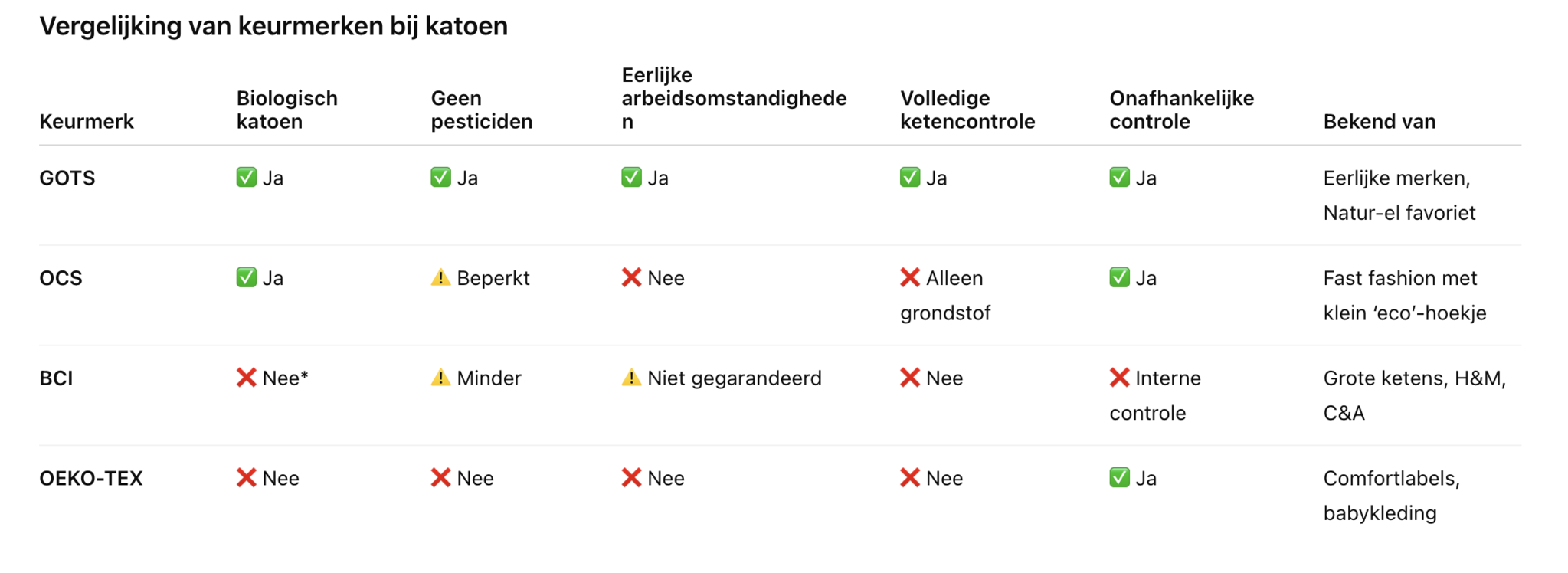
*BCI often uses conventional cotton, but does encourage farmers to work 'better' — without it being truly organic.
And yes, we are still learning every day too.
Because when I see that overview above, I have to swallow hard too. Because yes, our suppliers sometimes don't have the best certificates either. It might turn out that some cotton is not fully GOTS certified, or the wool is not entirely organic. The trick is to be mild as well as critical. Because what else does a brand do? Is 90% of the collection sustainable, but that one item just misses the certificate? There is usually a very good reason for that. Asking questions helps; what choice do they make and why? We also occasionally choose an item that is not 100% fully traceable. We could be sneaky and non-transparent about that, or we ask the supplier for the story behind it and aren't ashamed to tell you about it too. Nobody can do it 100% right all the time, but you can put your best foot forward: and that starts with an honest label, and not just shouting that something is sustainable when behind the scenes it is just plain bullshit.
Want to know more?
In the coming weeks, we will also explain the quality marks for other sustainable materials that you will find with us. That way, you know exactly what to look out for.
Do you have any questions? Feel free to ask – we are happy to share our knowledge!
Love,
Vera
Ps. Did you know that you can now filter by quality mark on our site?


